It is believed that epidemics did not occur in the American continent as in Europe, but diseases of an unknown nature devastated indigenous populations. “Virus epidemics are frequent events in human history” (Dr. David Romero Camarena, Mexico).
With the first ocean voyages (1492), the history of leprosy in America began and a second wave of disease progression followed, after the beginning of a decline in Europe. The first Hospital de Saint Lázaro founded in the new Spanish possessions was in Mexico. Second in Lima (1563) and third in the Philippines (1557). These were followed by those of Colombia in Cartagena (1598), Guatemala (1640), Havana (1667) and Quito (1799).
Colombian slave records from the mid-18th century describe cases of leprosy. There were “many cases of masters who had to sell their slaves at reduced prices due to the presence of lesions caused by leprosy.” “Hundreds of similar records contain information on the different diseases that free and enslaved black communities suffer, and most of the cases pertain to leprosy and / or syphilis.”
The leprosy disease began to be recognized in the territory, which is now Colombia, in the second half of the 16th century.
The racist image of leprosy as an extremely contagious disease affecting inferior peoples emerged from the imperialist expansion of Europe and the United States in the late 19th century.
At the beginning of the 20th century, leprosy went from being a suitable subject for charitable activity to being considered an obstacle to economic progress. This concern was compounded by reports that between 30,000 and 50,000 people were infected in the country. So “leprosy became a national shame for this progressive-minded nation.

The government and the medical community found the exaggerated late 19th century data on leprosy as a danger to their civilizing project, these anxieties gave the government the moral authority to enact tough new laws that force people with leprosy to be segregated and the doctors looked abroad for models to control the spread of the disease ”.
Between 1900 and the 1930s, the Colombian government imposed several norms that ordered the isolation of the sick and established special institutions for leprosy known as Leprocomiums and / or Lazarets, with particular characteristics such as the sanitary cordon, special legislation and currency. their own so that those affected by leprosy would not endanger the rest of society. These places were: Agua de Dios, Contratación and Caño de Loro. Around 1950, isolation remained the main strategy for controlling the disease, but medical rhetoric began to change. Doctors viewed leprosy as a curable disease and rejected compulsory isolation. The emphasis shifted to prevention and research. This new approach was connected with the liberal ideas that dominated at that time in Colombia.
Only until a few years ago has leprosy, with all its burden of social discrimination, ceased to be a serious public health problem, thanks to the demographic inversion that implied that the majority of the population was urban over the rural, from the 1950s on. of the twentieth century, to BCG vaccination practices, to an active search for cases and partners, to the availability of a truly effective therapy since 1985, and to the application of a broad national program of timely medical detection and management. The lazarettes disappeared as such. However, the disease still exists.
Dr. Hugo Sotomayor Tribin, Curator of the Leprosy Medical Museum, has divided the history of leprosy in Colombia into five periods Table Nº 1.
Lazaretto coins, which circulated in Leprocomium, these issues have become interesting numismatic curiosities for collectors.
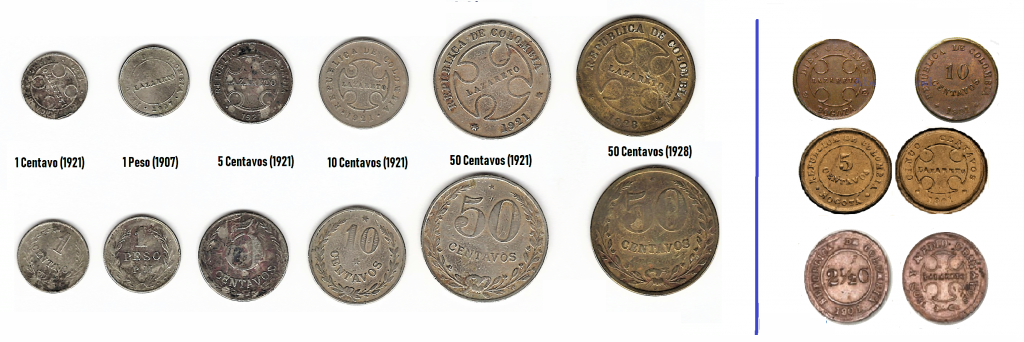
The Colombian government was troubled by the rapid spread of leprosy so much that they began to make distinct currency for their three colonies. There were only four series of colony coins issued, but each was under four separate administrations administrations. Leprosy coins were discontinued in Colombia after 1930.
The first issue of coinage started in March of 1901. Colombian president José Manuel Marroquín decreed that separate coinage was to be made for the leper colonies in the denominations of 2 ½, 5, 10, 20, and 50 centavos, or cents. This series bore the cross of Saint Lazarus on the reverse while its respective denomination and a laurel wreath appeared on the obverse. They were mainly made of bronze and bronze alloys.
The second issue of coins was under President Rafael Reyes.
This series did not bear the cross of St. Lazarus, however. All of these colony coins had the same face value as Colombian notes and were considered legal tender within the colonies; however, it was strictly prohibited to use them anywhere outside the colonies as it was widely believed that leprosy was a highly communicable disease. Many people of this era believed that using the same money as leprosy victims could expose them to the illness. Reyes was so adamant about reducing the cases of leprosy that he even went so far as to order the incineration of all paper money in circulation, replacing them with newly printed notes.
The penultimate series of coins to circulate was during the administration of Marco Fidel Suárez. In 1918, cupro-nickel coins were minted in denominations of 1, 2 and 5 cents, followed by 10- and 50-cent denominations in 1919. These coins were no longer etched with the “PM” mark, but were still equal to regular Colombian currency and also featured the Lazarus cross. The total face value of these was estimated to be approximately 100,000 pesos.
The fourth and final issue of coins was authorized by president Miguel Abadía Méndez. The entire series was struck in only 50-cent denominations and was composed of bronze alloy, often identified as red copper. The coins featured the 50-cent denomination, omitted the Lazarus cross on the obverse, and read, “República de Colombia. Lazarettes.” The coin acquired the nickname coscoja, roughly meaning “little thing” in colloquial Spanish.
Fountain:
https://leprosyhistory.org